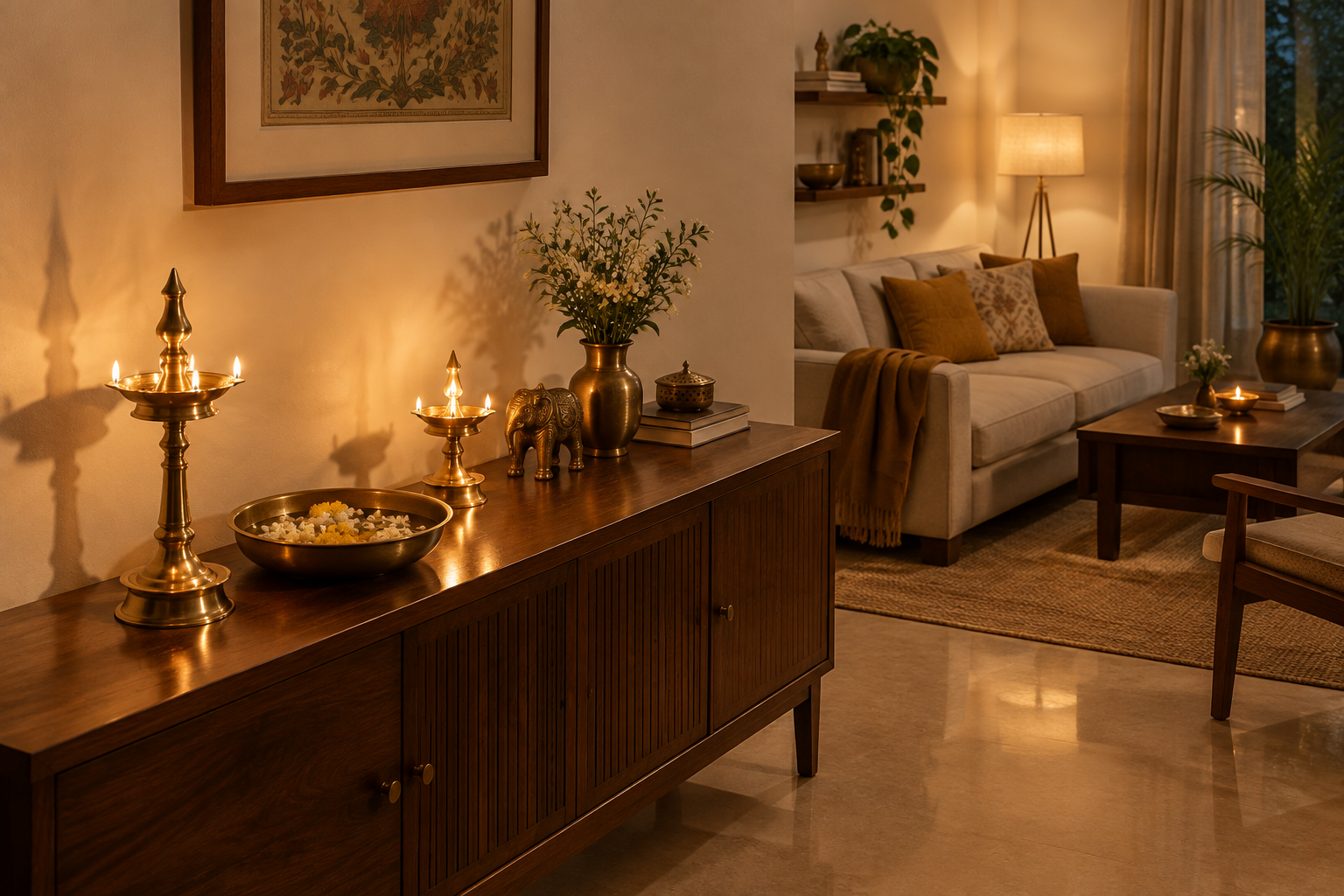
Every year the same thing happens in the first week of October. The shops fill up with plastic torans, glitter-edged rangoli stickers, and lights that blink in four colours at once. You want your home to feel like Diwali, but you also want to walk into your living room in November and still recognise it. Good diwali home decor sits somewhere between those two wishes: warm, lit, a little fragrant, and calm enough that you can actually enjoy it.
In this article
- Start with light, not with things
- Brass that earns its place
- Diwali home decor for a small home
- Scent and softness
- The entrance and the pooja corner
- What stays after the festival
Diwali has been celebrated across India for centuries, and the heart of it has always been light pushed back against the dark. You can read a little about that history in Sahapedia’s piece on the many shades of Diwali. It is a useful reminder that the festival never needed much. A lamp, a clean floor, a few flowers. Everything else is a bonus.
Start with light, not with things
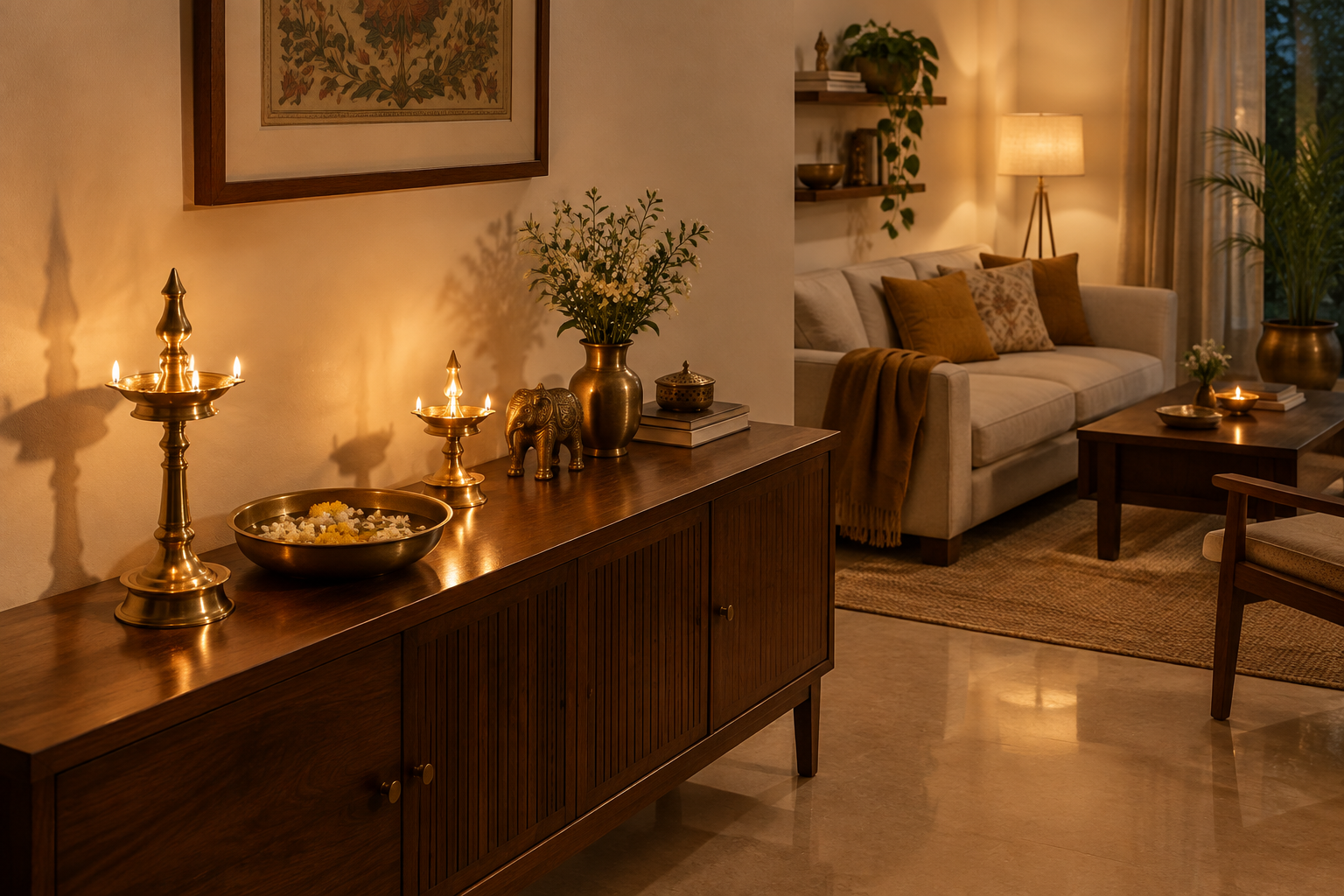
Before you buy a single new item, switch off the white tube light for one evening and see what your home looks like with only lamps and small flames. Most rooms improve at once. Corners soften, the walls pick up a golden cast, and the clutter you stopped noticing months ago simply disappears into shadow.
That is the real foundation of diwali home decor that feels warm. Think in layers. A low light near the floor, a mid-height light on a console or shelf, and one steady source such as a lamp with a 2700K bulb. Cool white bulbs at 6500K flatten everything and make brass look dull, so swap them in the rooms where you will actually sit during the festival days.
Then add flame. Not forty diyas lined up along every windowsill, but a handful placed with intention: three on the entrance console, two on the dining table, one in the bathroom if you like the idea. Odd numbers sit more naturally than pairs, and grouping them in a tray keeps wax and oil off your furniture.
Brass that earns its place
If you are going to spend on anything for the festival, brass is the sensible choice. It catches candlelight beautifully, it ages into a softer colour instead of looking worn, and you will bring it out again next year and the year after. Plastic and painted resin decor rarely survive one storage season.
A single statement piece does more than a crowd of small ones. A brass peacock diya is a good example. The detailing gives it presence even when unlit, so it works as a sculptural object on a shelf in the weeks before and after the festival, then comes forward as the main lamp on Diwali night. Place it where light from a window or a second lamp can reach it, and let it have some empty space around it.
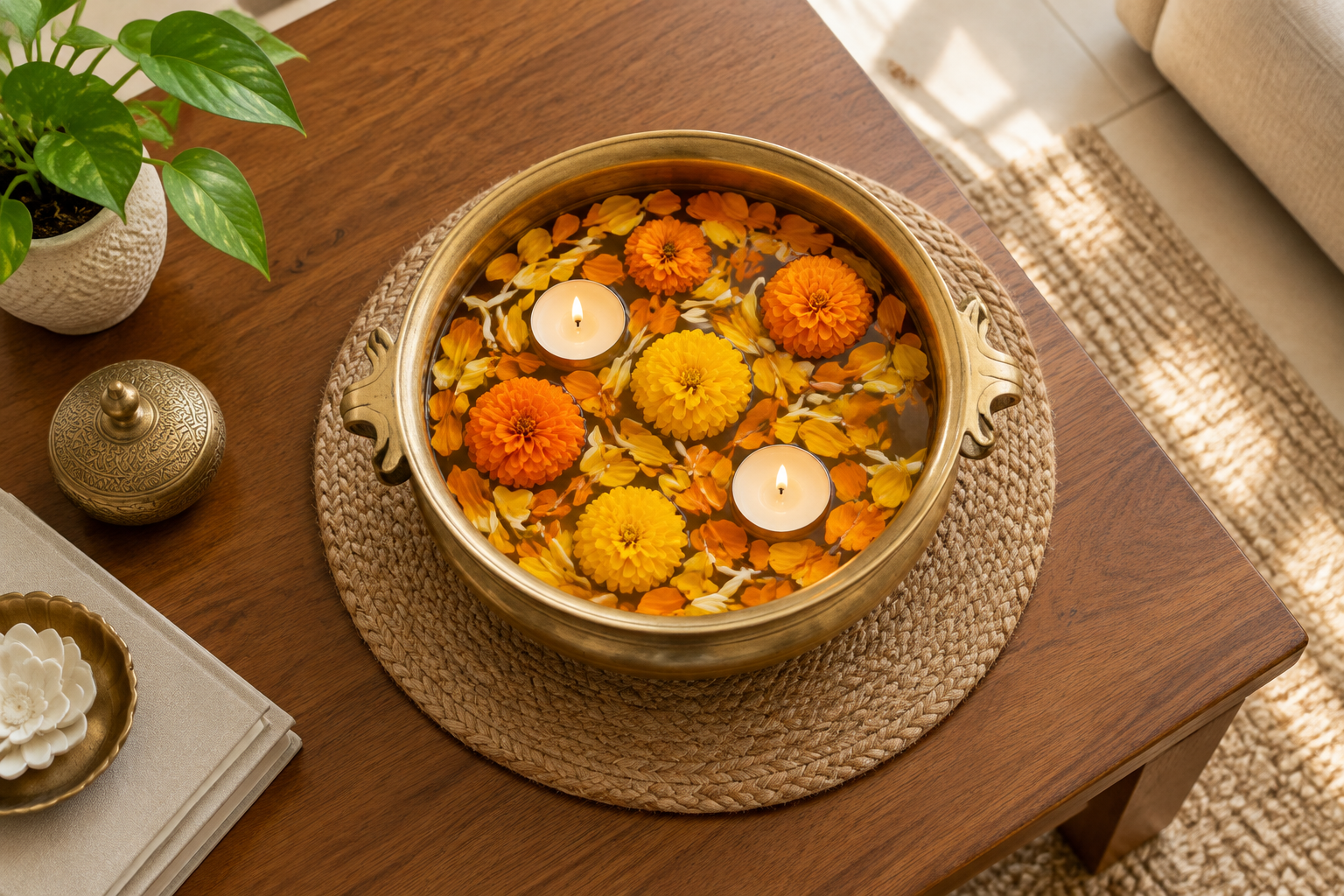
For something broader and quieter, a brass urli bowl is the piece many homes keep coming back to. Fill it with water, float a few marigold or rose petals, and set two or three tealights on top. It becomes a centrepiece for a dining table, a coffee table, or the floor beside the front door. When the festival is over, the same bowl holds keys or fruit and nobody would guess its other life.
Diwali home decor for a small home
A 1BHK or compact 2BHK does not have the wall space for a big festive display, and it does not need one. What it has is a few surfaces that work hard: the entrance shelf, the dining table, one corner of the living room, the pooja space, and maybe a balcony ledge. Decide which two or three of these will carry the festival and leave the rest alone.
Clear the surface first. Take everything off, wipe it down, and put back only what you love. Then add the festive pieces. A bare surface with three well-chosen objects reads as calm; a crowded surface with eight reads as stressed, even if each item is lovely on its own.
Small tealight holders are the most useful tool here because they scale. A brass tealight holder set lets you build a cluster on a tray in the evening and put it all away in a single drawer the next morning. Group them at different heights if the set allows, keep the cluster to a 30 cm tray or shorter, and leave a hand’s width of empty surface around it so the light has room to breathe.
Balconies deserve the same restraint. One string of warm white fairy lights along the railing, a couple of floor lanterns, and a small pot of marigolds is plenty. If you rent, use removable adhesive hooks instead of nails, and wrap lights around a plant stand rather than the grill if your landlord is particular.
The bedroom and the bathroom are often overlooked, but a single diya or tealight in each changes the mood completely during the festival nights. Place one on a small tray on the bathroom counter, and one on the nightstand. You are not decorating these rooms; you are simply letting the light reach them.
Scent and softness
A home feels festive through the nose and the hands as much as the eyes. Think of the smell of fresh marigold, ghee diyas, a hint of sandalwood. It is worth planning scent as deliberately as light.
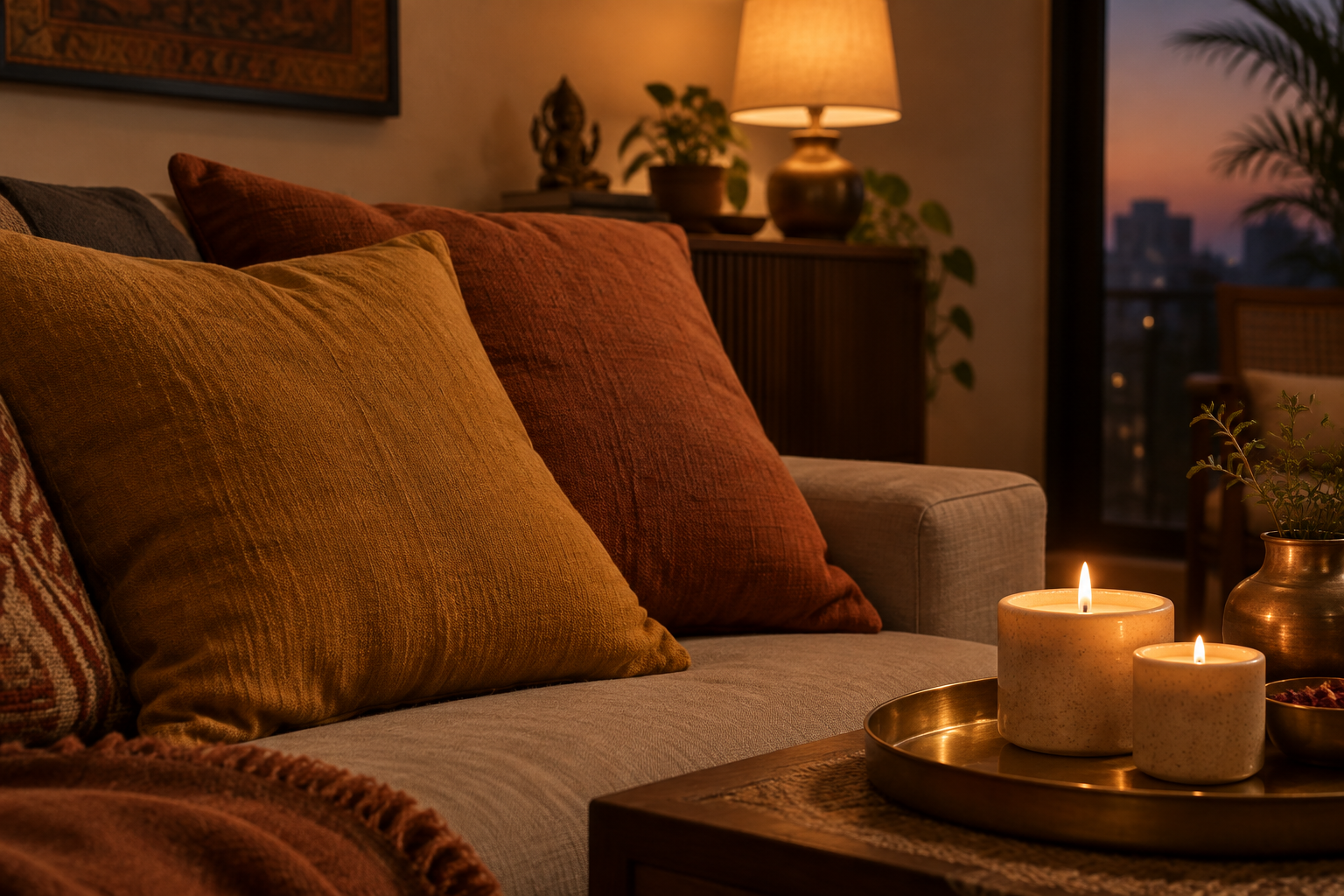
Keep to one or two sources. A scented soy candle set is a gentle way to do it, because soy burns cleaner and slower than paraffin, which matters in a closed apartment where you are also lighting incense and oil lamps. Choose warm notes such as sandalwood, amber, or vanilla and skip anything sharply floral or fruity; those fight with the smell of puja and cooking.
If you prefer traditional fragrance over candles, a small stick of dhoop or a single agarbatti in the living room is enough. The mistake is using five sticks at once and turning the air thick. One stick, lit fifteen minutes before guests arrive, fills a compact apartment gently. Crack a window if the room has no cross-ventilation.
Softness is the other half. You do not need new cushions, but a change of covers makes a visible difference. Look for cotton or linen in deep terracotta, mustard, ochre, or muted maroon, and avoid heavy sequins or zari that will feel out of place in February. A plain handloom throw over the sofa arm, a jute or cotton rug near the entrance, and a few fresh flowers in a steel or terracotta vase finish the room.
The entrance and the pooja corner
The doorway is where guests and family meet the festival first, so a little effort here is rewarded. A fresh marigold toran hung on the door frame, a small rangoli drawn in rice flour or flower petals, and a diya on each side of the threshold are enough. Skip the plastic garlands; real flowers cost little effort and smell far better.
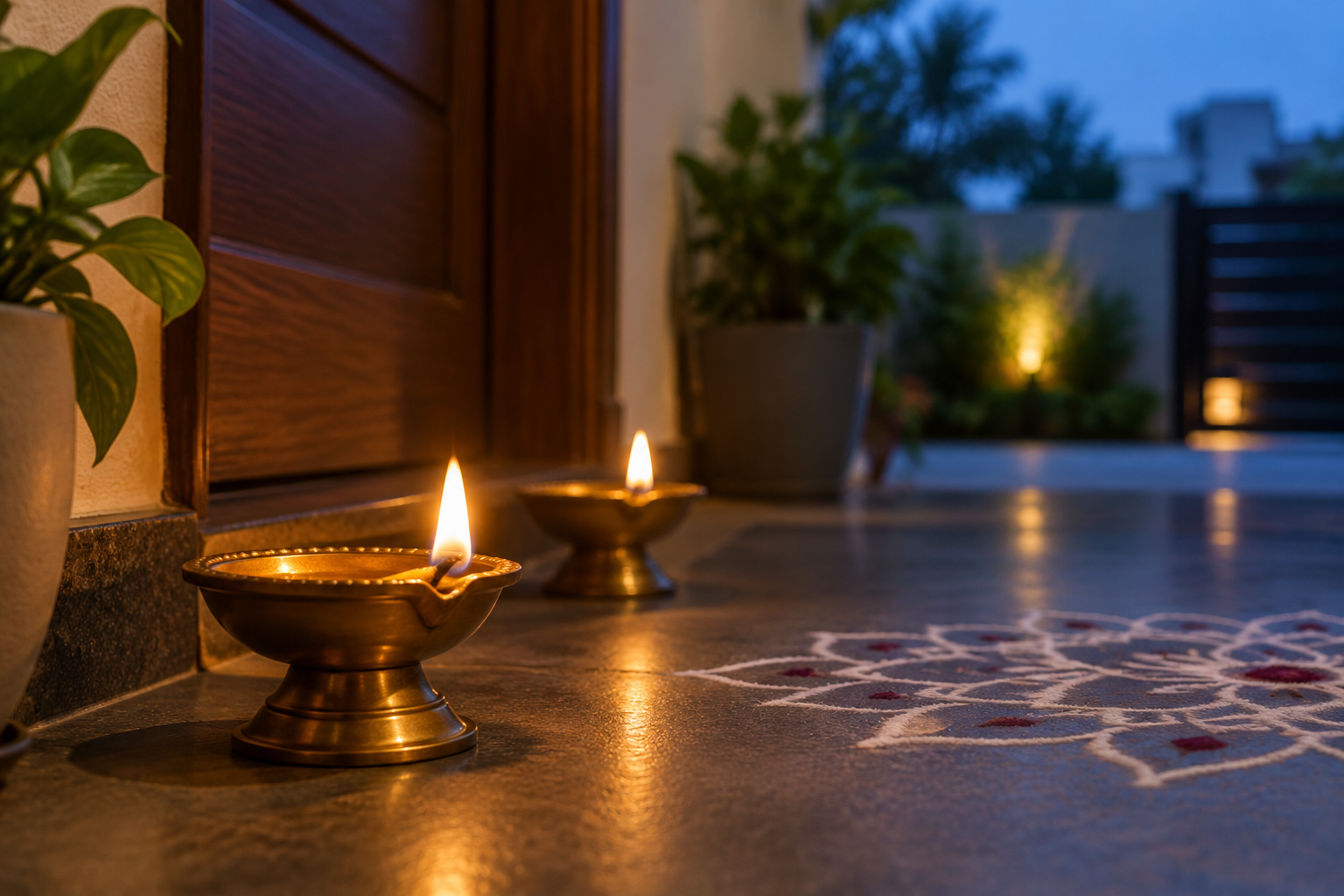
Inside, the pooja corner is the emotional centre of the home on Diwali, and it should look the calmest. Wipe the shelf, lay a clean cloth, and keep to the essentials: the deity, a lamp, flowers, and a small bell. If you want to understand how to arrange a compact space well, the ideas in our pooja corner guide translate easily to a festival setup. For Lakshmi puja evening, a silver-toned murti or a simple lamp in front of a framed print is all you need.
If you are also planning presents for family or hosts, our list of Diwali gift ideas for the home pairs well with this approach, since the same warm, lasting materials suit both gifts and decor.
What stays after the festival
One test makes every purchase easier: will this still look right on the second of November? Brass bowls, tealight holders, a good candle, and a linen cushion cover all pass. Glittery hanging stars and foil banners do not.
The best festive collections are built slowly, one or two pieces a year. This Diwali you add an urli. Next year, a pair of standing oil lamps. The year after, a set of hand-beaten bowls. Each piece carries a memory of a specific festival, and together they form something no shop display can replicate: a tradition that belongs entirely to your home.
When the days after Diwali arrive, do not pack everything away in one afternoon. Take the festival down in stages. Blow out the last diyas, let the brass cool, wipe off any oil with a soft cloth and a little lemon and salt, and store each piece wrapped in a cotton cloth so it does not tarnish unevenly. Keep the urli on the table a week longer, with fresh petals, and let the home ease back into its ordinary self.
Good diwali home decor is mostly subtraction. A handful of brass pieces, warm bulbs, one or two scents, real flowers at the door, and a pooja corner that is clean and quiet. Do that, and the house will feel festive without feeling dressed up. You will notice it most in the evening, when the first diya is lit, the room goes gold, and nothing in it is shouting.