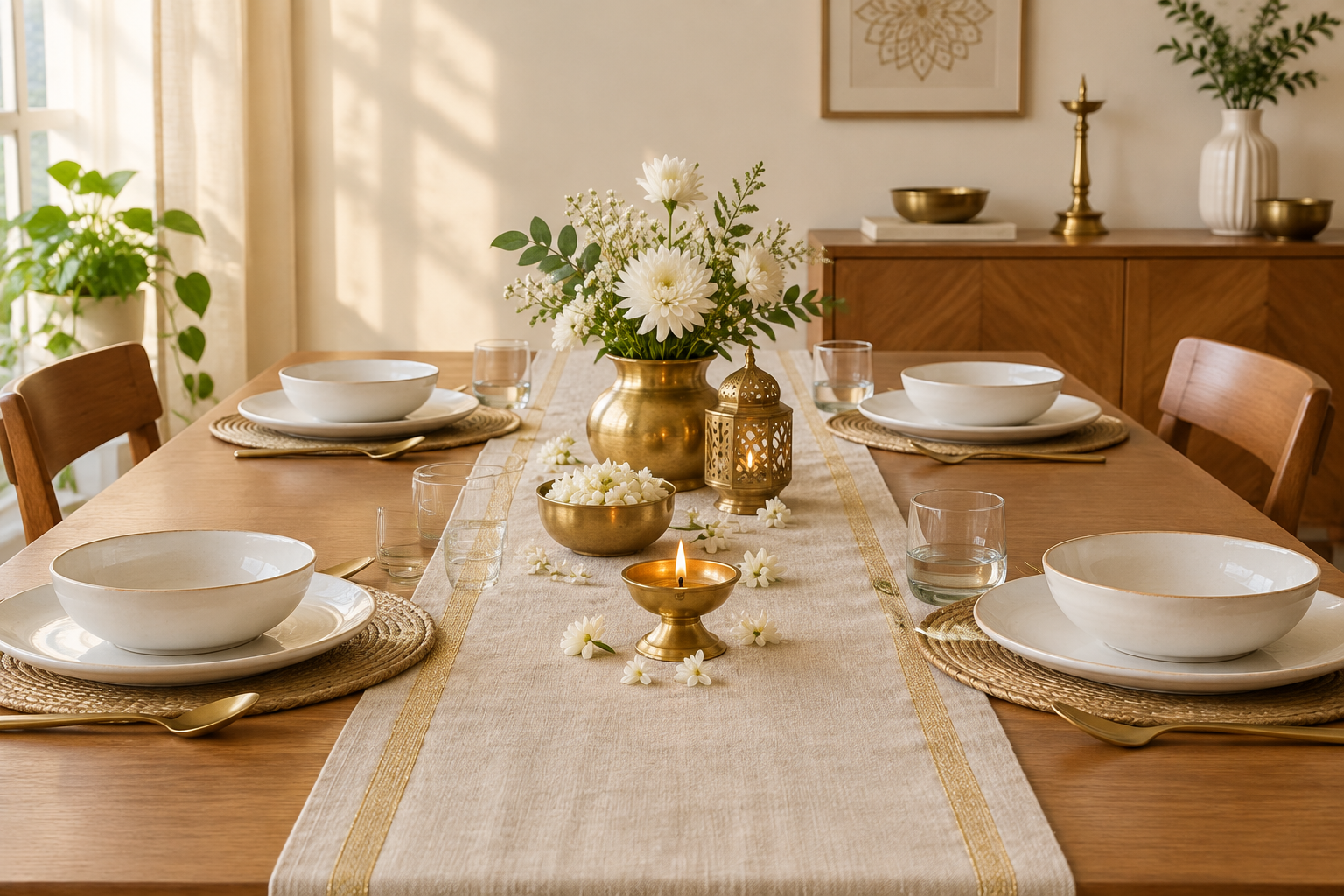
There is a particular kind of pressure that arrives with festival guests. The relatives are coming for Diwali dinner, the food is half cooked, and somewhere in your head is a picture of a table that looks like it belongs in a magazine. A good festival table setting does not need that much. It needs a clean surface, a few honest materials, and enough room for the food to be the centre of attention. This is how to put one together in a 1BHK or 2BHK without buying a whole new set of crockery.
In this Article
- Start with less
- The base of your festival table setting
- Plates and bowls that do the work
- Serving pieces worth putting out
- Napkins and cutlery
- Light and small touches
- Clearing up without dread
Start with less
Most festival tables go wrong through addition. One more bowl, one more decorative piece, one more colour of napkin. By the time the guests sit down, there is nowhere to place a glass of water.
So begin by subtracting. Decide on two or three materials and let them repeat across the table. Brass and white stoneware, for example, or steel and unpolished wood. When materials repeat, the table looks planned even if you assembled it twenty minutes before the doorbell rang.
Then pick one colour to carry the mood. Marigold orange, deep green, or a soft off-white all work, and you only need it in one or two places, such as the runner or the napkins. Everything else can stay neutral. A simple festival table setting is mostly a decision about restraint, made early, so that you are not making dozens of small decisions at the last minute.
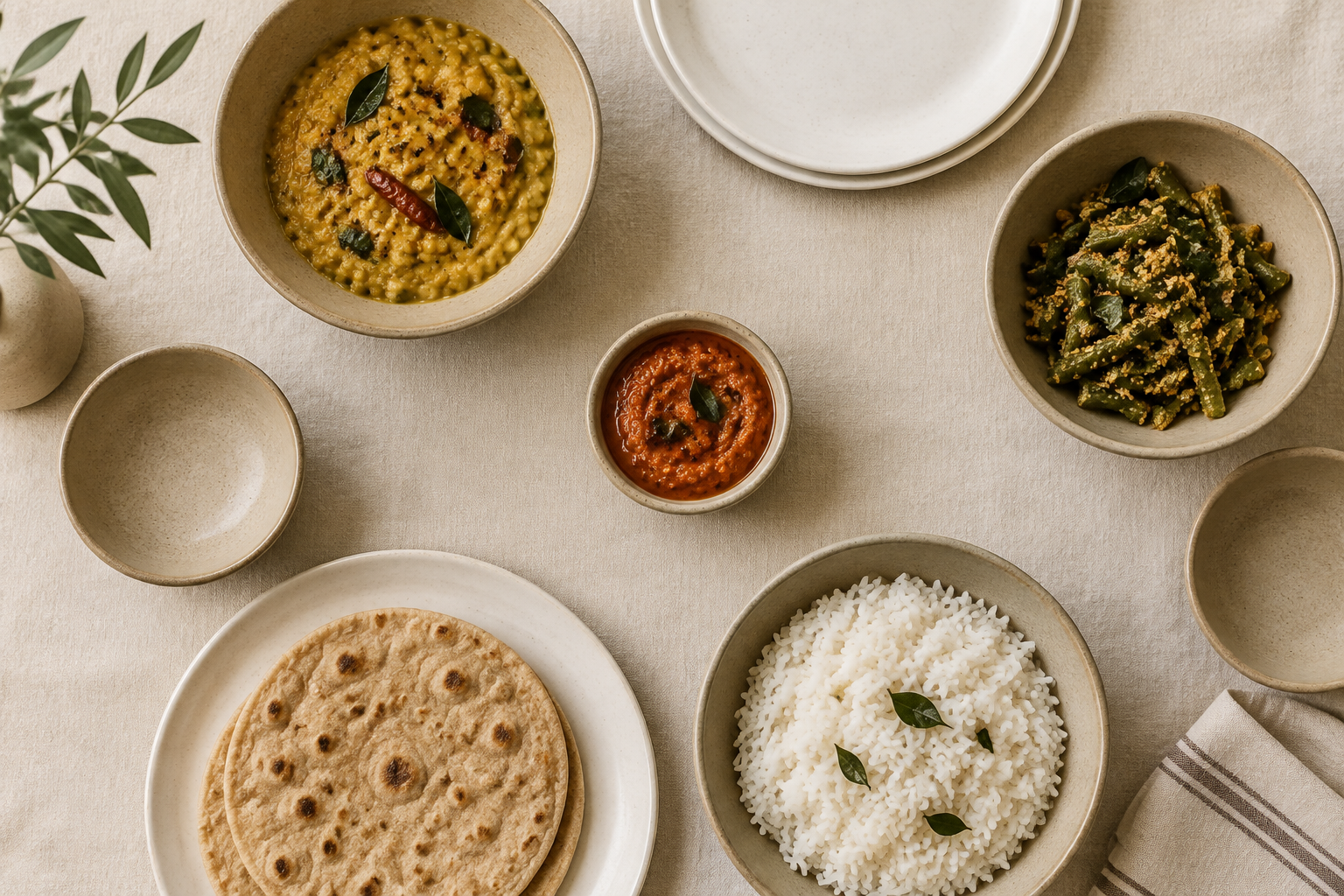
It also helps to think about how your family actually eats. If the meal is a shared spread with rotis, dal, two sabzis, rice and something sweet, the table is a serving counter first and a display second. Plan the layout around reaching, passing, and refilling. If you can picture an aunt reaching across the table without knocking a diya, you are on the right track.
The base of your festival table setting
Before anything goes on the table, look at the table itself. In a compact flat it is often a four-seater that stretches to six, sometimes a folding table borrowed from the balcony, sometimes the everyday study desk dragged into the living room. None of these is a problem. They only need a base that makes them look intentional.
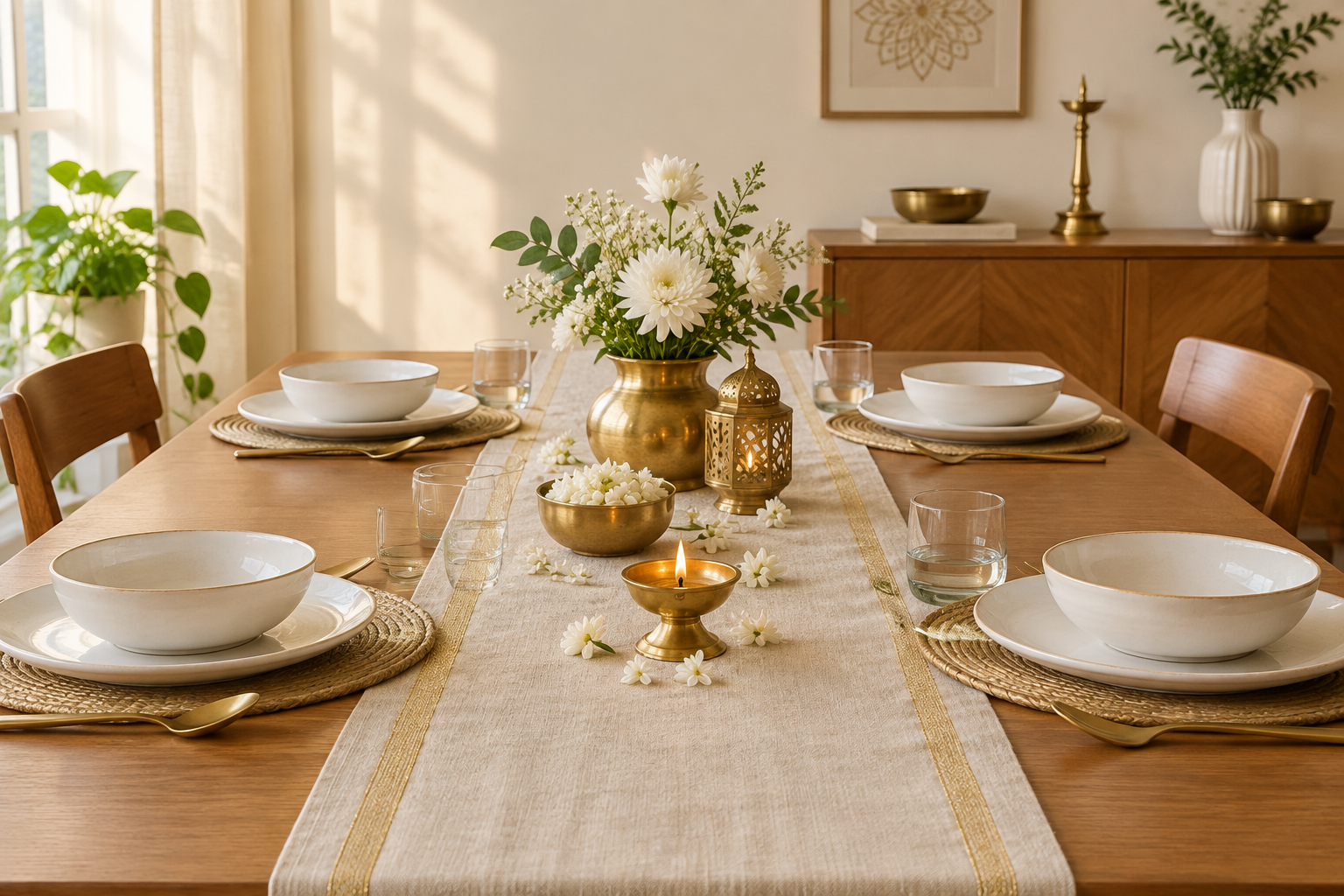
You have two good options. The first is a full tablecloth in cotton or linen, which hides a scratched or mismatched surface and gives the table a soft, even tone. The second is a runner laid down the centre, which suits a surface you like, such as sheesham or teak, and wish to show off. A runner should hang about 20 to 25 cm over each end of the table. Any shorter and it looks like an afterthought; any longer and it gets in the way of chairs.
Fabric choice matters more than pattern. Handloom cotton, block print on a plain ground, or a slubby linen blend will all drape well and survive being washed after a curry spill. Skip anything shiny or synthetic, which tends to slide and catches the light in a way that feels loud next to brass.
If you are also getting the rest of the home ready, the checklist in our guide to getting guest-ready in one hour pairs well with this. A quick reset of the entrance and living room takes the pressure off the table.
Plates and bowls that do the work
You do not need a matching 12-piece dinner set. In fact, a table with slight variation often feels warmer than a perfectly uniform one. What you need is enough plates for everyone and a consistent feel across the bowls.
Plain white or cream plates are the easiest foundation. They make dal look richer, greens look fresher, and gulab jamun look like the event it is. If your everyday plates are patterned or chipped, borrow or buy a small set only for guests and store them with the festival decor.
For bowls, a set of ceramic bowls in a matte, earthy glaze is a quiet workhorse. They hold raita, chutney, payasam, or a small portion of dal at each place, and the glaze catches candlelight without glare. Choose a size that fits comfortably in one hand, roughly the width of your palm, so that guests can lift them without effort. Stoneware and ceramic also hold heat well, which matters when the sabzi is meant to arrive warm.
Layer the setting in the order people will use it. Plate at the centre of each place, a small bowl set slightly to the upper left, a glass above the knife side. Leave about 3 cm between the plate edge and the table edge so nothing feels as if it might slide off. If you are short on space, skip the bread plate entirely; rotis can sit on the main plate or in a cloth-lined basket in the middle.
Steel katoris are a perfectly good alternative in any festival table setting. In a polished finish they look crisp against a cotton cloth, and they have the advantage of being unbreakable when children are at the table. Mixing a few steel bowls with ceramic ones works if you keep the shapes similar.
Serving pieces worth putting out
Here is where a festival table setting earns its character. Serving pieces are the one place where a little more effort shows, and they are also the pieces you will use on the table for years.
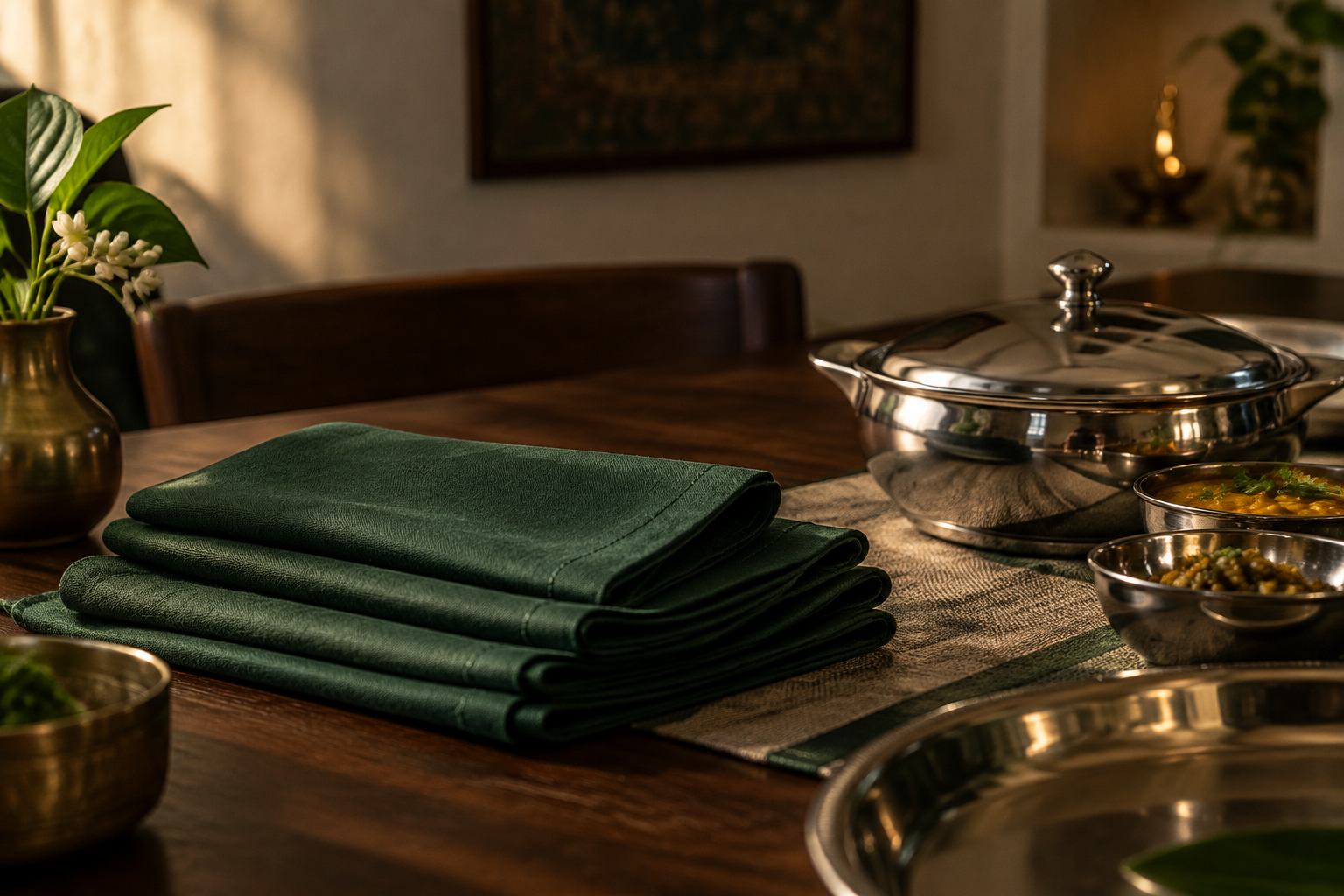
Food that stays in the cooking vessel looks rushed, but food moved into a good serving dish looks considered. A stainless steel casserole set of three solves two problems at once. The lids keep rice, rotis and dal warm through a long evening of conversation, and the polished finish looks right next to brass and cotton. Use the largest for rice or biryani, the middle for dal or a gravy, and the smallest for a dry sabzi.
Group the serving pieces in the middle of the table, close together, rather than scattering them at each corner. A tight cluster looks generous. A wide scatter looks sparse and forces people to stand up to reach. Leave a clear lane on either side of the runner so plates can travel freely.
Vary the height gently. A wooden board or a small stand under one dish lifts it a few centimetres and gives the eye somewhere to travel. You do not need anything dramatic; one raised piece is enough. A glass carafe of water placed at each end keeps hands from reaching across and adds a clear, cool note against the warmer materials.
Sweets deserve their own moment. Set mithai on a small brass plate or a wooden tray at one end of the table, away from the savoury dishes, so it reads as a separate course. If you want more ideas on which brass pieces are worth keeping beyond one festival, this piece on brass diyas and urlis covers the ones that age well.
Napkins and cutlery
Paper napkins are practical, but cloth ones change the whole feeling of a festival table setting. They soften the edges of plates, add the colour you chose earlier, and make guests feel that someone thought of them in particular.
A set of cotton dining napkins in a solid colour is the most useful thing you can own for this. Cotton absorbs well, which is the only job a napkin truly has, and it softens with every wash. Choose a shade from your one colour decision: deep green, terracotta, ochre, or a warm white. Avoid heavy embroidery or sequins; they snag and make the napkin hard to use.
There are three easy ways to fold them. Lay one flat under the fork for a clean, minimal look. Roll one loosely and tuck it into the bowl for a casual feel. Or fold a napkin into a rectangle and rest it on the plate, with the cutlery on top. None of these requires skill, and none will collapse if someone touches it.
For cutlery, think about how your guests eat. Many families eat with their hands, and a Diwali dinner table is no exception. Put out a spoon for each person, and a fork only when the menu needs one, say for a salad or dessert. Place the spoon to the right of the plate, bowl side up. Setting out cutlery nobody will use adds clutter without adding comfort.
A small tip on handwashing. In many homes, guests wash their hands before sitting down, and it helps to leave a clean cloth or a few extra napkins by the basin. It is a small gesture that people remember.
Light and small touches
Lighting does more for a festival table setting than any object you can place on it. Harsh white tubelight flattens food and faces alike. If you can, switch off the overhead light and rely on lamps, string lights, and flame.
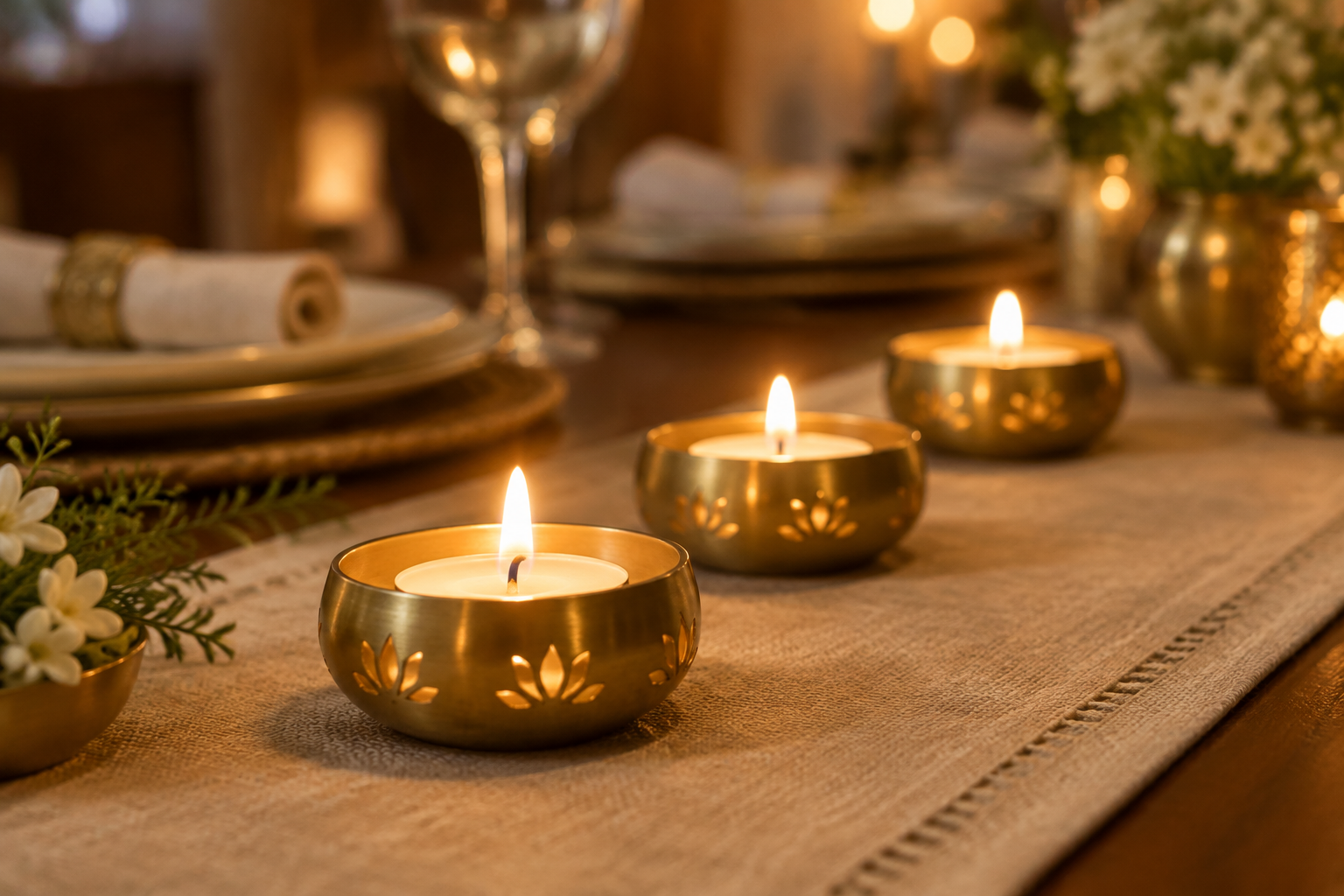
A brass tealight holder set is the simplest way to do this. Place three or five holders down the centre of the runner, with uneven spacing, and light them just before guests sit. Brass reflects the flame and warms the whole surface, and the small size means they will not block anyone’s view across the table. Keep them at least 15 cm away from napkins and any dried flowers, and never place them where an elbow might reach.
For other small touches, look to what you already have. A few marigold heads floated in a shallow steel bowl. A handful of rose petals scattered along the runner. A short brass vase with a single stem of tuberose. Keep every object below eye level, around 15 cm tall at most, so that conversation flows across the table without leaning.
Scent is worth a thought, too. Flowers with a strong fragrance compete with the food, so keep the strongest ones, like tuberose or jasmine, at the entrance or on a side table rather than the dining table. The aroma of cardamom, ghee and roasted spices is already doing that work.
If you are still deciding on the overall mood of your home for the season, the ideas in our Diwali home decor guide carry the same palette from the doorway to the dining room. For background on how the festival itself is traditionally celebrated, Sahapedia’s exploration of Diwali traditions is a thoughtful starting point.
Clearing up without dread
A festival table setting you dread clearing is not a good one. Think about the end of the evening while you set it up, and you will thank yourself at eleven at night.
Start with a clear plan for dishes. Keep a tray or a large steel thali near the kitchen door, and as guests finish, stack bowls and plates on it. Scrape leftovers into a single container before anything reaches the sink. Soaking steel and ceramic in warm, soapy water while you pack away the food saves a great deal of scrubbing the next morning.
Once the festival table setting is cleared, cloth napkins and the runner should go straight into a basket or a bucket, not onto a chair. Rinse any oily stains in cold water before the wash, since heat sets turmeric and oil. A little dish soap rubbed in with your thumb lifts most marks.
Finally, store the festival pieces together. A single box or shelf holding the runner, napkins, tealight holders and guest plates means that next year, and the Holi lunch after that, you can set a table in ten minutes. The best festival table setting is the one you can repeat without effort, and that repeatability is what keeps hosting a pleasure.
Set the table the evening before, if you can. Stand back, turn off the main light, and light one tealight. If it looks calm and ready, you are done. The rest of the evening belongs to the people and the food.